
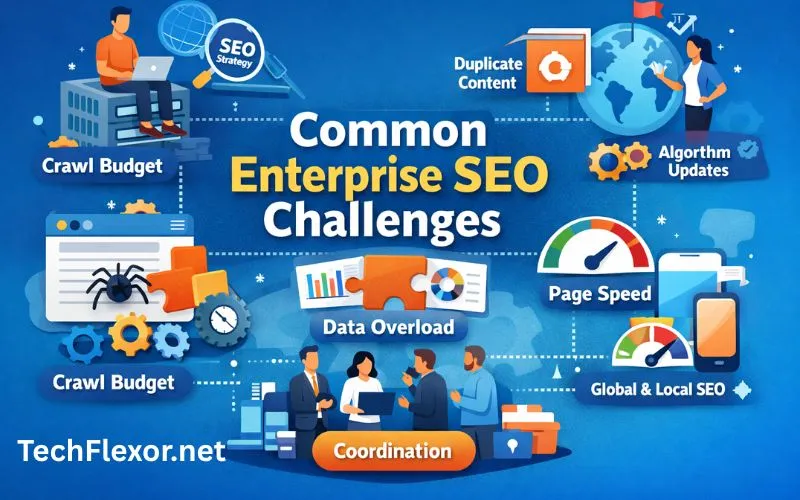
Enterprise businesses face common enterprise SEO challenges that can hinder growth and reduce visibility on search engine results pages (SERPs). Managing large websites, coordinating multiple enterprise departments, and maintaining consistent SEO strategy across brands require careful planning and execution. Technical issues, duplicate content, and inefficient workflows further complicate enterprise SEO management, while global operations add layers of complexity in international SEO management.
Overcoming these obstacles demands a structured approach that integrates enterprise digital strategy, centralized oversight, and collaboration across teams. Understanding these challenges is the first step toward creating scalable, high-performing SEO solutions that boost traffic, engagement, and overall enterprise search visibility.
1. Aligning SEO Strategy With Business Goals
Enterprise companies often struggle to connect optimization efforts with revenue outcomes. A strong enterprise SEO strategy ensures that search initiatives support broader enterprise marketing goals and contribute directly to growth. Without alignment, brand managers, marketing teams, and SEO specialists pursue disconnected objectives that weaken overall impact.
Successful organizations create a measurable unified SEO vision supported by SEO governance and structured planning. Many enterprises also collaborate with specialized tech marketing agency experts to integrate SEO into the wider enterprise digital strategy, allowing teams to track outcomes through defined KPIs and improve enterprise search visibility consistently across departments.
2. Managing Complex Website Architecture at Scale
Large platforms often contain thousands of pages, categories, and subdomains. Poor structure harms crawling efficiency and weakens enterprise search performance. A clear hierarchy supports enterprise site optimization, helping users and search engines navigate the digital ecosystem smoothly.
A scalable architecture depends on a shared SEO implementation framework supported by a centralized SEO team. Organizations adopting modern operational systems and technology-driven market services often achieve better structural scalability and improved workflow efficiency. With proper brand alignment strategy, enterprises maintain consistent navigation, URL structures, and internal linking systems that strengthen authority across the entire enterprise brand ecosystem.
| Architecture Element | Enterprise Benefit |
| Clear taxonomy | Faster indexing |
| Logical URLs | Better user trust |
| Internal linking | Improved authority flow |
3. Crawl Budget Optimization for Large Websites
Enterprise platforms frequently waste crawl resources on duplicate or low-value pages. Effective enterprise SEO management focuses on crawl efficiency so search engines prioritize high-value content aligned with search intent and business goals.
Using a structured technical SEO framework, teams apply indexing controls and monitoring systems to guide bots efficiently. Proper crawl management strengthens enterprise search visibility while improving long-term SEO performance monitoring through reliable technical signals.
4. Handling Duplicate Content and Canonicalization Issues
Duplicate pages appear naturally across enterprise sites due to filters, regional versions, and product variations. Without strong duplicate content prevention, rankings become diluted across competing URLs and weaken authority.
Correct canonical logic combined with hreflang tags supports accurate regional page targeting and improves language targeting signals. This ensures each version serves the right audience while supporting global SEO strategy and protecting performance across international markets.
5. Scaling Content Strategy Without Losing Quality
Enterprise publishing often prioritizes quantity over relevance. A scalable enterprise SEO strategy must balance volume with meaningful user value. Content should reflect localized search intent, audience expectations, and consistent messaging across brands.
A structured shared SEO framework enables brand SEO consistency while allowing brand-level optimization. Businesses that streamline operational workflows — including financial and administrative systems like business cheque solutions — often find it easier to scale content production efficiently. Through cross-brand collaboration, organizations share insights, maintain quality standards, and strengthen authority throughout the enterprise content network.
6. Technical SEO Management Across Thousands of Pages
Maintaining technical health becomes challenging as websites expand. Broken links, slow loading pages, and inconsistent schemas reduce rankings and disrupt enterprise SEO processes.
Automation supported by modern SEO tools and advanced optimization techniques allows teams to maintain stability. Continuous auditing improves enterprise search performance while ensuring scalable performance optimization across growing platforms.
| Technical Area | Enterprise Solution |
| Crawl errors | Automated audits |
| Page speed | Code optimization |
| Structured data | Central templates |
7. Enterprise Data Management and SEO Analytics Overload
Enterprise SEO generates massive datasets from multiple sources. Without structured analysis, insights remain unused. Strong enterprise analytics tools combined with KPI tracking transform raw data into strategic decisions.
Organizations rely on Google Analytics, Adobe Analytics, and advanced analytics platforms to enable deep segmentation and data segmentation. A consistent SEO reporting framework supports data-driven optimization and accurate regional performance analysis across markets.
8. Coordinating SEO Across Multiple Teams and Stakeholders
Enterprise SEO involves many enterprise departments, making SEO coordination difficult. Developers, marketers, and leadership often operate separately, slowing execution.
A clear SEO communication strategy supported by project management tools improves stakeholder collaboration and cross-team alignment. Effective SEO workflow management ensures consistent implementation and strengthens organizational collaboration across teams.
Visit Techflexor.net for more details.
9. International and Local SEO Complexity
Managing global brands introduces challenges related to culture, language, and regional behavior. Effective international SEO management requires deep understanding of cultural search behavior and regional expectations.
Successful enterprises implement multilingual SEO, geo-targeted content, and advanced content localization strategies. Proper hreflang implementation ensures visibility in international SERPs, improving global search visibility while matching local audience needs.
10. Maintaining Page Speed and Core Web Vitals at Scale
Large enterprise platforms often struggle with performance due to heavy scripts and integrations. Slow pages reduce engagement and weaken SEO performance across devices.
Consistent monitoring and scalable engineering solutions enable sustainable performance optimization. When speed improvements align with overall SEO strategy, enterprises enhance user satisfaction and strengthen rankings across competitive markets.
11. Scaling Link Building and Authority Growth
Enterprise link acquisition requires structured outreach rather than random campaigns. Strong authority growth depends on a coordinated multi-brand SEO strategy supported by inter-brand SEO support.
Digital PR initiatives combined with consistent keyword research help build trust signals. A unified approach strengthens authority across the entire enterprise brand ecosystem, improving visibility and credibility simultaneously.
12. Keeping Up With Algorithm Updates and Market Changes
Search algorithms evolve continuously, affecting enterprise websites more dramatically due to scale. Organizations must adopt flexible systems supported by continuous SEO performance monitoring.
A resilient strategy combines SEO governance, adaptive workflows, and proactive experimentation. By aligning optimization with changing market trends, enterprises maintain stability while improving rankings across dynamic search engine results pages (SERPs).
Conclusion: Building a Scalable Enterprise SEO Future
Enterprise success depends on structured execution rather than isolated tactics. Companies that build a strong enterprise SEO strategy, supported by cross-brand collaboration, scalable workflows, and data intelligence, create sustainable growth within their digital environment.
Modern enterprises must integrate compliance considerations such as GDPR compliance SEO, regional regulations SEO, and broader legal SEO considerations. Working closely with legal teams ensures effective privacy compliance strategy and responsible advertising compliance, allowing organizations to scale confidently while maintaining trust and long-term visibility online.
Learn more about us or contact us to publish your content.